
Fact Sheet
Vulva And Vagina
All about getting to know and enjoying your vulva.
Share


Not everyone experiences or relates to their vulva and vagina in the same way or uses the words used in this factsheet for their bodies. We support you using the language that feels best for you.
Here are some tips on taking care of and enjoying your parts if you have a vulva and vagina.
Know your parts: External Genitals
Vulva
- The vulva is the whole genital area: labia majora, labia minora, clitoris (and clitoral hood), vagina, and the opening to the urethra.
- The vulva is often referred to as the “vagina”, but technically your vagina is the muscular canal leading from your outer genitals to your cervix and uterus.
Lips (Labia)
- The word labia literally means “lips” in Latin.
- There are two types of genital lips: outer lips (labia majora) and inner lips (labia minora).
- The outer lips consist of fatty tissue and contain many blood vessels. When sexually aroused they can swell and become sexually sensitive.
- The inner lips connect from your clitoral hood to your vaginal opening. They keep bacteria away from the vagina.
Clit (Clitoris)
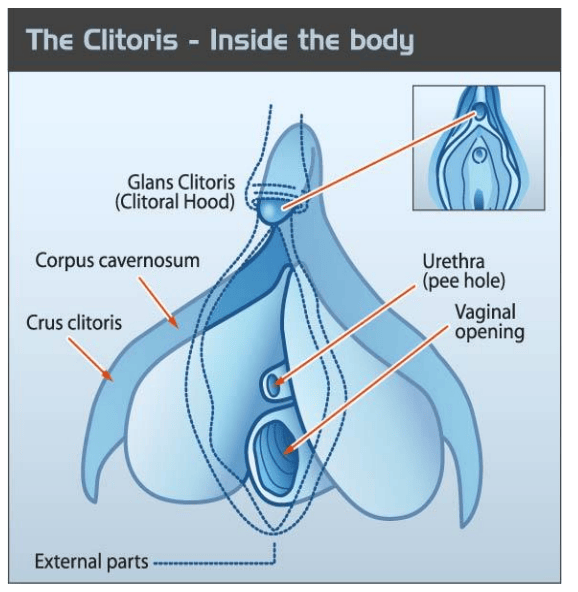
- The clit’s single purpose is pleasure and it is packed with thousands of nerves.
- The clit is located under the clitoral hood, which is where the inner lips meet at the top of the vulva.
- The clitoral head (glans) is what’s visible under the clitoral hood. The head is part of a larger structure that is mostly inside the body.
- During sexual arousal extra blood rushes into the clit and it may get erect and swollen. The clit may also get sensitive to touch.
- The size, colour and shape of the clit can vary among individuals.
- Some people’s clitoral head (glans) may have been removed or altered through genital modifications such as cutting/female genital mutilation (FGM). If you have any concerns about this, you can speak to your clinician.
What does a clitoris look like?
Opening to the urethra/urethral opening
- The urethra carries pee from your bladder. The urethral opening is where pee comes out.
- It is located below the clit and above the vaginal opening.
Know your parts: Internal Genitals
Vagina
- The vagina is the canal that connects the vulva to the cervix, uterus and fallopian tubes.
- The vaginal canal is 3-4 inches long when not aroused.
- The vagina in sometimes referred to as the birth canal, as this is where a baby passes through during vaginal childbirth.
- The vagina is where penises/toys/fingers/tongues may enter during vaginal penetration.
- The walls of the vagina are often naturally lubricated like the mouth. This fluid is made mostly of water that the body produces.
- Vaginal walls can also self-lubricate when sexually aroused.
Hymen
- The hymen is a thin tissue that may ring around or stretch across the opening of the vagina. Everyone’s hymen is different.
- The hymen has at least one opening to let fluid out of the vagina.
- The hymen may be stretched from vigorous activity or injury (using tampons, being penetrated, riding a bicycle, etc). Bleeding or discomfort may or may not happen the first time your hymen is stretched.
Cervix
- The cervix is the lower part of the uterus, where the uterus connects with the top of the vagina.
- The cervix has an opening that lets sperm and fluids pass through
What does a vulva look like?
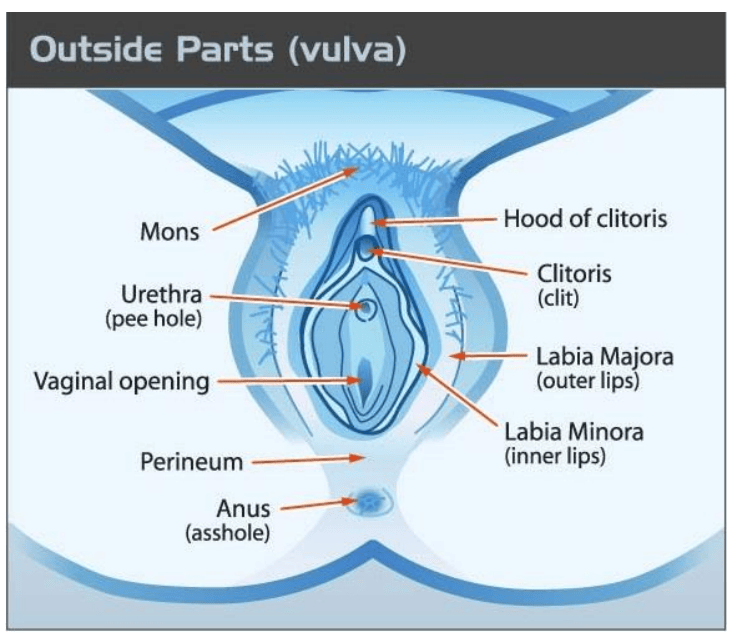
- Vulvas (lips, clitoris, vagina) come in all shapes, sizes and colours.
- It’s normal for lips to change or deepen in colour throughout life.
- Outer lips often have pubic hair and sometimes the hair covers the rest of the vulva.
- Inner lips may vary from each other in size, shape and length. Some inner lips are exposed and longer than the outer lips, while others may not be visible without spreading your outer lips.
- Sexual arousal may make your vulva increase in size and change colour.
- How someone’s vulva looks does not impact their ability to enjoy sex or be a good sexual partner. Sex is about how you interact with your partner(s), not the look of your body parts.
- One of the best ways to love your body is to be comfortable with it. If you’re unhappy with how your vulva looks, it can help to think differently about your body. Look for partner(s) who make you feel good about your body.
What comes out of your vulva and vagina?
Squirting/“Female” ejaculate (Cum)
- The Skene’s glands make ejaculatory fluid, and are located near the opening of the urethra.
- When you’re about to ejaculate, you may feel pressure near your bladder, similar to when you have to pee. Ejaculatory fluid is often mistaken for pee, but it is chemically different.
- This fluid is watery and not slippery. It can come out in small trickles or it may “squirt” out.
- Ejaculation/squirting may happen when you have an orgasm, but not always. Not everyone ejaculates.
Sexual arousal fluid
- When sexually aroused, the body may naturally produce lubricating fluid that is cloudy or clear and feels wet. This fluid acts as a natural lubricant that may make sex more pleasurable. It also helps prevent condoms from breaking.
Cervical mucous (Discharge)
- The cervix makes mucous that varies in thickness, texture and colour throughout the fertility cycle. This might be visible on underwear.
- Cervical mucous is often cloudy at the start of the menstrual cycle and becomes clear and stretchy closer to ovulation. At ovulation, cervical mucous can help sperm survive as they travel up the uterus. It also lubricates the vaginal walls and protects the cervical opening.
Blood
- Blood comes out of the vagina every month as part of the fertility cycle. This is called a period. The amount and frequency is different for everyone.
- Spotting (often brown or light pink) is a small amount of blood that comes out at times other than during a period.
- Some people with vulvas don’t have periods.
Urine (Pee)
- Urine comes from the bladder, travels through the urethra and exits out of the urethral opening.
Taking care of your external and internal genitals
Health
- The vagina is self-cleaning and does not need any special soaps, cleaners or douches. These may disturb the natural, normal balance of bacteria found in the vagina, and can cause vaginitis (inflammation of the vagina).
- Soaps and menstrual products that are fragranced and have irritating chemicals can dry or irritate the vulva.
- Wiping from front to back is a good way to avoid dragging bacteria from the anus (butt) to the vulva.
- The vulva has a natural scent that comes from sweat and bodily fluids. If you notice a scent that is unusual for you, talk to your health care provider.
- The vulva and vagina do not need to be cleaned after sex.
- Peeing after sex can lower risk of a urinary tract infection (UTI).
- What’s normal is different for everyone. If something is unusual for you, it’s a good idea to check in with a healthcare provider.
Grooming
- Some people like to groom their pubic hair, and others prefer to let it grow. This is a personal decision and has no impact on sexual health. If you decide to groom, here are some things to keep in mind:
- There are different ways to remove hair, including: scissors, clippers, shaving, waxing, depilatories (chemicals that break down the hair), electrolysis and laser hair removal.
- For methods that do allow hair to grow back, it will not grow back longer or thicker than before.
- Many people go to professionals for hair removal. If you are visiting a professional, ask about their equipment-cleaning practices.
Cervical Screening (formerly Pap Tests)
- A cervical screening is a medical test used to find changes HPV infections that can lead to cervical cancer and changes to cells in your cervix.
- Ontario guidelines recommend that anyone who has a cervix get a screening test every 5 years starting at age 25.
Pleasure zones
- Some people find it very pleasurable to have their clit touched with fingers, mouths or vibrating toys. Some clits need more or less pressure, some like being touched only on a part of the clit and some don’t like being touched at all. Many people are able to reach orgasm through clitoral stimulation.
- The “g-spot” refers to a group of very sensitive tissues inside the vagina. Some people are able to find their g-spot by inserting two fingers or a toy a few inches deep and pressing on the wall of the vagina towards your belly button. Touching the g-spot can sometimes make you feel like you need to pee, even if you don’t.
- Some people find vaginal penetration to be very pleasurable, but many people do not reach orgasm from penetration alone.
- The perineum, the area of skin between the anus and the vagina, is filled with lots of nerve endings. Some people find having their perineum touched very stimulating.
- Lots of people like to stimulate or be stimulated in other areas. Some of these “hot spots” can include ears, neck, nipples, armpits, thighs, butt, and feet to name a few – have fun and explore!
Arousal
- When you are aroused, blood flows to your vulva, causing your clit and lips to swell and become more sensitive to touch.
- The vagina becomes naturally lubricated. Factors like medication, genital surgery (vaginoplasty), hormonal fluctuations during your menstrual cycle and/or stress may affect how much the vagina lubricates.
- The physiological response of arousal may happen whether or not sex is consensual. Arousal can be involuntary and happens when the body is stimulated. Feeling aroused does not necessarily mean that you want to engage in sexual activity. It is important to ask for and give consent verbally.
- Arousal can change over time and depending on your emotional state or where you are in your fertility cycle. For example, some people are really aroused and enjoy having sex during their period.
Orgasm
- Orgasm involves several involuntary contractions of the muscles in your vagina, perineum, and anus (butthole).
- Many people think that arousal involves a steady climb to the peak of arousal (orgasm) and then levels off. However, arousal is not always linear or directed, and levels of arousal can go back and forth and up and down. This is completely normal.
- Some people orgasm multiple times in a short time. Some orgasms last longer, and some may be more intense than others.
- Everyone has their own pace of reaching orgasm; it could take minutes or hours to reach orgasm.
- Orgasms may help relieve cramping during your period.
- Some folks may have never experienced the type of stimulation that works for their anatomy, and may have never had an orgasm. This doesn’t mean that they never will have one.
- You can have fun without having an orgasm! Not all sexual activity has to end with an orgasm (your partner’s or your own).
Self-pleasure/masturbation
- Masturbation is stimulating your genitals or other parts of your body in a way that feels sexually pleasurable. You can masturbate alone or with someone else.
- People may use their hand(s), objects or sex toys to pleasure themselves, while others use their imagination, porn or erotica.
- Many people masturbate, including people of all genders, abilities, sexualities, ethnicities, cultures, religions, and ages, as well as people who are single or in relationships.
- Masturbation is healthy and normal. It’s a great way to learn about your body and find out what feels good for you. It can also relieve stress, and there is no risk of sexually transmitted infections (STIs) or pregnancy.
- Masturbating cannot hurt you or physically change your body. You cannot get sick, go blind or grow extra hair from masturbating.
- You can masturbate as much as you like as long as you are still enjoying other activities in your life too. Some people masturbate several times a day, some a few times a week, and others every once in a while.
- Everyone is different and it’s important to find out what feels right for you.
- Choosing not to masturbate is okay too.